Looking back its been a very interesting few years, and its crazy to think this chapter in my life will be over in a few weeks. Its exciting to move forward, but at the same time the future is unknown which makes it seem scary at times. IB has had a large impact on shaping the person I am today, and it has made high school a time to remember. It's crazy to finally complete the course that I tried to get out after the beginning of junior year. IB has helped me grow as a scholar and has helped me grow as an individual. I certainly feel that I have experienced a lot of my growth in English, which is a testament to you.
Thank You Ms. G!
Sunday, April 24, 2016

Sunday, April 10, 2016
Blog Post #14
While scrolling through Whitman's Journal I really struggled to make out any words in his passages. Because of this I focused mostly on the pictures. I really liked the pictures because they were very simple sketches but they still had distinct characteristics. Also, I noticed how every picture is drawn from the side, there is not a single picture that is drawn as a portrait. I find this interesting because it gives the picture more room for interpretation. What I mean by this is that the emption, or connections to the person drawn, is not distinctly revealed because it is drawn from the side.
After going over the journal entries a second time and gaining some insight on Whitman's sketches I made some new discoveries. First, I hadn't noticed the stamp of the Library of Congress. I find this stamp interesting that it was on the majority of the excerpted pages from his notebook. Also, in his writings I was interested on Whitman's views of religion. I thought it was interesting how he saw religion as a centrifugal force and also how he saw religions influence on slavery. Also, in his paintings it was cool to see the meaning behind Whitman's details. For example, he had one painting with clear detail on the characters nose. I found it interesting to learn that this was due to the characters affections towards beer and wine. This could reveal some insight on Whitman's status in society. Having a wine connoisseur as a close friend could indicate Whitman's appreciation towards the fine arts which tends to be a characteristics of a man of luxury.
After going over the journal entries a second time and gaining some insight on Whitman's sketches I made some new discoveries. First, I hadn't noticed the stamp of the Library of Congress. I find this stamp interesting that it was on the majority of the excerpted pages from his notebook. Also, in his writings I was interested on Whitman's views of religion. I thought it was interesting how he saw religion as a centrifugal force and also how he saw religions influence on slavery. Also, in his paintings it was cool to see the meaning behind Whitman's details. For example, he had one painting with clear detail on the characters nose. I found it interesting to learn that this was due to the characters affections towards beer and wine. This could reveal some insight on Whitman's status in society. Having a wine connoisseur as a close friend could indicate Whitman's appreciation towards the fine arts which tends to be a characteristics of a man of luxury.
Sunday, March 20, 2016
Blog Post #13
In my opinion, when I think of the “American Dream” I seem to think of the right for the pursuit of happiness. I really like this right, which is guaranteed in our constitution, because it is just so awesome. It can mean so much and be something completely unique to every individual. When I think of the American Dream, I think of a blank canvas. I strongly believe that it is the opportunity for everyone to do what they wish to do.
America is often called the land of opportunity, and often that opportunity is in regards to a chance to gain wealth. Wealth to me is more than just money. To me, wealth consists of knowledge, and emotion, and I guess also money. I think wealth is very interesting because it is something that is very personal. One’s perception of wealth can be completely different than another person’s perception of wealth.
 In general, the attitude towards wealth and poverty is pretty defined in America. The American perception has a distinct line of income known as the poverty line that formally identifies the poor. Also, there are certain tax brackets that identify “the wealthy.” What is important to consider, is that the American perception is the perception of the American government, or America as a whole, not necessarily the people. I find this aspect very important because that is what causes a divide between my views on wealth and poverty and my peers views, as opposed to the American views.
 Sunday, March 6, 2016
blog post #12
#1:As Gregor Samsa awoke one morning from uneasy dreams he found himself transformed in his bed into a gigantic insect.
- This sentence is very simple. The syntax flows and the diction is not very strong. The sentence is plain.
- The imagery created is very simple. It doesn't seem neither positive or negative.
#2:Gregory Samsa woke from uneasy dreams one morning to find himself changed into a giant bug.
- This translation is very similar to the first one, it is almost more streamlined for it takes out the details of being transformed in his bed. This sentence is very straightforward, with little description, but still conveys the same plot.
- The imagery is not very descriptive.
#3:When Gregor Samsa awoke from troubled dreams one morning he found he had been transformed in his bed into an enormous bug.
- This translation entitles a more startled connotation.
- It emphasizes the dream he had, and that it was troubling
- It emphasizes what he was turned into, an enormous bug.
- This translation has a greater focus on the tenses of each verb, “had been transformed,” this more specific translation seems more literal.
#4:One morning, upon awakening from agitated dreams, Gregor Samsa found himself, in his bed, transformed into a monstrous vermin.
- This translation creates a more cynical tone. This is created by the parallel of the two adjectives, agitated and monstrous. This both have strong negative connotations.
- also he used vermin instead of bug, which is more powerful.
- The imagery is very vivid in this translation. The vermin is described as monstrous, and the horrific nature of the bug is emphasized by the segmented structure of the sentence. It doesn't flow, so it draws attention to every clause.
Original: Als Gregor Samsa eines Morgens aus unruhigen Träumen erwachte, fand er sich in seinem Bett zu einem ungeheuren Ungeziefer verwandelt.
 The meaning of a text is unique to every text. It is impossible to rewrite a sentence with the exact same meaning because of so many factors including word choice, syntax, punctuation, and imagery. This is what makes translating so difficult. You can never get the exact translation, because of these factors. In my Latin class, we do a lot of work with translating texts from latin to english, and analyzing the texts and it is always interesting to see how much of the texts are lost in translation, because there is so much more to a text then just the words.
One of my favorite latin poems is Catullus 85. This poem is only two lines but the structure is so precise that it only take Catullus two lines to get his meaning across. For example, I have analyzed the first three words of the poem, “Odi et amo” [I hate and I love] and the last word of the poem, “excucior” [I am crucified]. These terms are so unique because they start and end the poem, but also the, I am crucified, symbolizes the crossing of the two emotions of loving and hating. This is emphasized further, for “Odi et amo” and “excruciior” have the exact same metrical beat when scanned. These aspects of the poem are only present when the text is in latin, english just doesn't do it justice. What fascinates me about this poem is just how precise everything is in this poem. Once it is translated, it loses part of its meaning, this same concept is present in Kafka’s metamorphoses.
Odi et amo. quare id faciam, fortasse requiris
nescio, sed fieri sentio et excrucior
I hate and I love. Why do I do this, perhaps you ask?
I do not know, but I feel it happen and I am crucified
Sunday, February 21, 2016
Sunday, February 7, 2016
Blog Post #10 cover art


When looking at all four pieces of the cover art, it is very hard to draw similarities and differences because the four covers seem so independent. They each look so unique that it is hard to imagine that they all are covers for the same book. The first cover portrays a blonde haired girl sitting in a lush field full of sunshine. This represents a positive interpretation of the novel. Maybe a love story perhaps. The second cover art represents a blurred image of a girl. This cover could represent the interpretation of the clones. The different interpretations on whether the clones are real people or fake copies. The third cover is a quite image of a small boat in a lake. This image could represent a tragedy of some kind. In this cover, the title Never Let Me Go is emphasized way more than any of the other covers which could make the viewer think of a romantic tragedy similar to the Titanic. The fourth cover shows very simply drawn human organs that are outlined in barbed wire on a cold blue canvas. This is a depressing portrayal of the novel that emphasizes the clones purpose which is for the extraction of their organs.
I chose to further examine the second cover and the third cover.
When I first look at the second cover I immediately thought of a girl, but then there is some hesitation. It obviously is a girl, but then why is it so blurry? Is it actually a girl? I question weather it is a real girl because of how blurry the image is. It causes a sense of mystery about the girl. This mystery could represent the blurred line between science and humanity. This cover would be created by a more scientific artist and would be designed for someone intending to read science fiction. There is a hint to the cultural construction of the clones that is whether the clones are real and if it is humane to extract their organs. This appeals to the scientific aspect of the novel.
The third cover is a little more ambiguous. A theme of the novel does not immediately jump out at me. However, when I do look at this cover, the title stands out to me in this one more than in any other. If I had never read the book before I would imagine a spin off of the Titanic. With my knowledge of what the book is actually about, I would draw a connection to the boat and Hailsham. The boat is isolated which could show the isolation of Hailsham. This could be a lake on the property of Hailsham. It is interesting that you cannot see anything in this picture besides a boat and a lake. This could represent that no one really knows what goes on at Hailsham. Looking at the boat closer I noticed that there is no paddle. When I saw this my mind started thinking that the boat is a representation of an escape for the clones. The problem is that there is no paddle so the clones never could escape. Dun dun dun. This cover would appeal to someone who wants to read a mystery or a depressing rendition of a love story with a twist.
Sunday, January 24, 2016
Blog Post #9
Andrew Fitzgerald: Adventures in Twitter fiction
https://www.ted.com/talks/andrew_fitzgerald_adventures_in_twitter_fiction/transcript?language=en
 This talk discusses the creation and the relevance of real- time story telling. The speaker, Andrew Fitzgerald, explains how new formats often create new stories. He starts with the example of how Radios were a new medium in the 1930s and how the radio connected thousands of people to listen to something happening in real time. He also discusses the new format of Twitter, and how this created 140- character or less stories, in both fiction and nonfiction. Fitzgerald discusses how with this new market, authors are able to receive instant feedback from their audience. He discusses that an author can tailor stories to the needs of his audience because there is no longer any middle man, or publisher between him and his audience. He discusses how this allows the audience to have a large impact on the actual creation of the story. In one instance an author tweeted the first line of her new book and her audience commented their own personal perspective of what they think should happen next. This gave the audience a lot of control on how they think the story should be played out. Fitzgerald proceeded to discuss a new trend known as "twitter fiction." Twitter Fiction is when people create parody twitter accounts for characters or people in real life and tweet things how they assume that person would tweet. The example used in the video is a foul mouthed parody of Chicago Mayor, Rahm Emanuel. Fitzgerald discusses how this is able to interact with the real world while also preserving a flexible identity and anonymity.
Fitzgerald does a good job of interacting with the crowd. His purpose is to explain, and he does so in a light hearted way. Fitzgerald is a member of the News and Journalism team from Twitter, so he is very credible with his information. The audience can tell that this is a subject that Fitzgerald has witnessed and understands. Fitzgerald does a great job of showing examples of what he is describing. He uses examples that the reader can relate to or has most likely encountered or seen something similar to. A negative of his argument is that his topic is just not a main issue. His topic is interesting, but has no real substance, so it is important that he gives it meaning. He is able to give it meaning through his use of emotion. He does not use strong emotions for this is not a serious issue, but he makes it seem interesting by using a sense of fascination. This allows the reader to also connect with what he is saying.
I chose this video because I was intrigued by the title. I use twitter and I was interested to see how it had an impact on storytelling. This talk did not discuss tragedy or pity, but it did discuss duality. Fitzgerald identified how something can be viewed online from a number of different perspectives and how these perspectives can cause a duality on one topic. Also, he explains how the lines of fiction and nonfiction can blur together creating a sense of duality.
Sunday, January 10, 2016
Blog Post #8
In your mind, are there any heroes in Double Indemnity? If so, who?
 In my opinion there are no Heroes in Double Indemnity. In the film the closest character to being a hero is Walter Neff. He is the brains of the operation and was the one who thought of the whole conniving plan. At times he possesses hero- like qualities but he also has many flaws about him including his motifs.
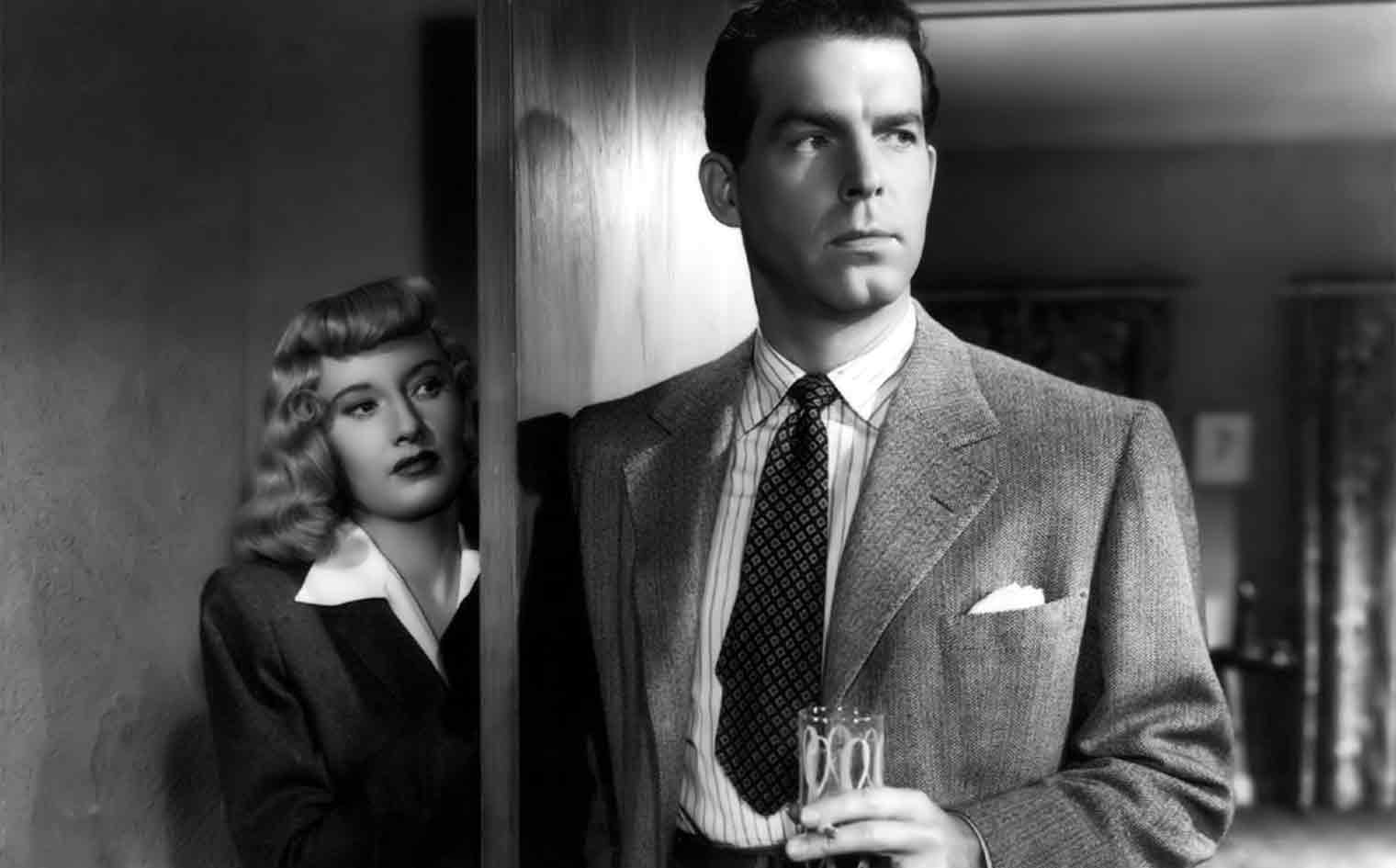
With Walter Neff, his biggest flaw is his motif. The motif for Walter Neff's actions is love or even lust. In my opinion, in order for someone to be considered a hero they should do the right thing for the right reasons. Now this is a very vague definition because I think not all heroes wear capes. There are heroes in day to day lives including military soldiers, fireman, and english teachers. The one thing that all these people have in common is that they are helping others, they are looked up to. Walter does not have these qualities, I believe the Motif for Walter's actions are not good enough to classify him as a hero. He is not saving Phyllis, he is helping her kill her husband. The reason he may have been considered a hero in the slightest is that it could be argued that his motif is love. Love is a very powerful motif but it is not justification for murder. Also, after the crime is committed there is doubt that the same feelings they had before were still there, which makes love a very shaky platform.
This film is a film noir so it emphasizes cynical attitudes and sexual motivations, both of which are present in Double Indemnity. We first see a relationship form between Walter and Mrs. Dietrichson when Walter comes over to sell insurance when Mr. Dietrichson is out of town. The encounter between the two characters is flirty and suggests a romantic relationship between the two. The film goes on and the two see each other until they form the plan to kill Mr. Dietrichson. This is when we notice the downfall of Walter. He reaches a point when he is easily persuaded by Mrs. Dietrichson just as Macbeth is controlled by Lady Macbeth. Walter is persuaded to the point of killing another human, sound familiar? Because Walter is so flawed by love it is not possible for him to be considered a hero. Sorry Walter.
Subscribe to:
Comments (Atom)